My Linux preferences
Last updated : 29/8/2026 (stub/WIP) (XOrg because XLibre M.S.I.)
Introduction
Welp, here I am, reminiscing over my old choices of Linux stuff.
Use cases
Before anyone starts wondering what kind of shit I use my current daily driver laptop for, allow me to list them, sorted by importance from the highest priority.
- As a self‐admitted Windows user, GUI is a must for me. I don't mind using terminal, but only for as long as required and for certain tasks where GUI is not the most practical approach (like upgrades).
- Personal data management (music, videos, pictures, etc.). USB (with read/write access) and a fully functional file manager is mandatory for this operation.
- Site writing, which required a single text editor. Though Geany ended up ruining every other text editors for me.
- Occasional web browsing.
- Media playback (audio and/or video), assuming I am in the right time & place for it. Though most of the time it's on the G710EAW.
And no, this use case does not rely on directly connecting to YouTube and/or its frontends.
- Maybe as a hotspot when I jam in an ethernet up T470 and enable tethering so I can connect stuff to that. That said, I find this impossible in connman so I reverted to NetworkManager just for this.
- Gaming (of any kind, whether it's native Linux games or emulated games from PSP or Windows). That said, I don't always have the time to regularly play Windows or Linux games (and I mostly play PSP on my G710EAW nowadays) so this is the least important part for me. Besides, the G531GD still handles (and torrents) Windows games so there's that as well. 4/8/2026 Update : Late Luanti/Mineclonia addition.
Fixed vs. rolling release
To me, fixed releases & rolling releases don't matter that much as long as I can readily reproduce my computing environment with as little difficulty as possible.
Distros
For the distro, Artix is the only distro I can say I would use (16/6/2026 update : on Devuan for now), even though most of the time Linux distros don't matter that much to me. That said, aside from the ones I've already written below, there are those that caught my attention the wrong way, which I listed directly below.
- Nyarch Linux : Arch Linux (with either GTK4 (GNOME) and/or KDE Plasma, as of 6/5/2026) with prebuilts for weebs (including an AI assistant that runs computer commands). Not sure on how I would (let alone could, considering GTK4 and/or Flatpak) get the AI stuff (not that I wanted it, let alone need), but I can just STFW for anime wallpapers (and Nyarch's catgirl downloader (archive.org) listed its sources) and stick it to the background (or even stick it to /usr/share/backgrounds and make it the lockscreen background) for my own weeb system; all while skipping the issues Nyarch brought in addition to Arch Linux's inherent issues.
- CachyOS : Arch Linux (again) but with added optimizations. Or Manjaro with a more justifiable excuse for holding back packages (as they compile their packages with optimizations). You could get some of their special sauce by getting their kernel from the AUR (and/or use their repositories), but then you should ask yourself whether the AUR is a reliable source for your kernel updates (and if you use their repos, cuckflare). 6/5/2026 Update : The higher‐ups of CachyOS supports age verification (substack mirror) and attacks those questioning it (substack mirror).
- Joborun (archive.org) : JwmOpenBOxRUNit. Dependent on cuckflared SourceForge (to be fair it was donated by sysdfree), though I appreciate them taking the extra step of skipping more corporate‐controlled things like elogind and zstd (and using pre‐October 2024 Linux kernels).
Additional resources : Codeberg(wiki) / Diaspora(JS & XHR required to browse) / Disroot Git(wiki)
- Omarchy. Skill issue tools on the higher castes, pride in cuckflare. Ouch. Credits to Eggmanplant for this.
- LCOS : Bryan Lunduke's highly loaded take of Devuan.
Linux Mint (and the distrohop fail arc)
At first (with the Dell 5485 still in my hold), I went for Linux Mint (with Cinnamon DE), as my first dive to Linux. And stuff mostly worked there... except for the touchscreen. Sure, touch input is recognized, but at that time, the cursor didn't disappear (I dunno, Cinnamon issues at that time?). And so begins my misguided distrohopping into various other distros until I crashed into Manjaro.
As for my experiences with Linux Mint, I didn't really use it all that much aside from occasionally livebooting it to fuck around with some system files.
Manjaro (and various DEs, ending with Gnome 3)
So begins my first foray into Arch‐based distros and my experiences with various DEs and their (mostly similar) interactions with the touchscreen. And, well... as far as I knew at that time, only Gnome 3 hid the cursor, which led to me falsely thinking the 5485's touchscreen fully works at that time. That said, my desktophopping (it's like distrohopping except it was the DE that changed instead of the entire distro) did come from the minimal Manjaro installation and I eventually gained enough experience to hop straight to Arch. Granted, I had the advantage of having an additional screen & 2 guides (one less verbose & more to‐the‐point than ArchWiki) to do so.
Looking back, I think I made the right move jumping off Manjaro, considering better alternatives exist even within its own niche of providing a more beginner‐friendly Arch‐based distro (Artix does them too) and the controversies surrounding Manjaro (not to mention the issues of Arch Linux that Manjaro inherited and excarberated with their delayed packages).
Arch Linux (and the end of my touchscreen era)
And we're at the final stop (would be final had Arch not stuck to SystemD, but we'll get to that). With Arch... nothing much changed, except I eventually learned to install Arch (and Artix later on) using just the default documentation (ArchWiki or Artix Wiki depending on which Arch distro I'm on).
As for the touchscreen? Welp, that thing actually wasn't as "functional" as I thought. Even with Gnome 3 (and various touchscreen setups), only one finger was recognized, which nuked my chances at properly playing PPSSPP on my 5485 with the touchscreen (which is something I LIKED to do at that time, and I mostly play Gran Turismo PSP on my G710EAW nowadays). And so, the 5485 was returned to Windows 10, where it would eventually die. That said, at that time (somewhere around 2021‐2022 I suppose?), I also started following Luke Smith, leading to me getting a Thinkpad X220 (which has since been sold by the time I wrote this, that laptop is SHIT) and diving to Artix from there.
I (and Luke Smith as well, by the way) also forgot to mention that Arch Linux (and the AUR by extension) does not separate proprietary software from the rest of their repos. For example, Arch extra contains Discord & Vivaldi; with multilib having Steam. As for AUR... I dunno. I think Chrome & Spotify topped the list but there are more I'm not aware of. But then again you can just not install them so it isn't that much of an issue.
21/4/2026 Update : Certain Arch Linux contributors (Dylan M. Taylor & Allan McRae) planned to add age tracking to archinstall (archive.org) and pacman (archive.org). In addition, some Arch Linux contributors has shown hostility against XLibre. Whether this hostility was justified or not, I cannot say. However, XLibre in its current form did not make a good impression.
Artix (Artix to Arch for me was kinda Pale Moon to Firefox for Dig Deeper)
And here we are, at the previous final stop (since 4/6/2026) that is Artix. With the insanity of systemd, it is only inevitable that Artix would soon become the only distro I would use (sure we have other non‐systemd distros like Alpine, Chimera, Devuan, Gentoo, and Void). And I did stick with Artix (and eventually made an installation guide), which says something about what the devs were doing. 21/4/2026 Update : Artix developers do not plan on adding age verification (archive.org).
That said, not all is perfect in Artix.
- Most Artix resources (including the entire artixlinux.org sites) are behind the cuckflare, which is always a red flag (especially considering Artix has been adding privacy‐aware browsers (including the fake privacy browser called WaterFox) in their repositories). Fortunately, not all of their resources are, as I can still update using some of the Asian (Japan, Korea, Singapore) mirrors without getting stopped by my own cuckflare IP blocker (Disroot /NixNet).
30/8/2026 LATE update : Artix forum & wiki demands cookie, JS, & XHR to pass their antibot verification thing which also blocks archive.org crawlers.
- As respectable removing systemd was, elogind is shaping up to be the next big obstacle.
- I was forced to dinit if I didn't specify which init I used on elogind (yes, apparently I cannot just basestrap /mnt base $init, I have to basestrap /mnt base elogind‐$init). 10/7/2026 Update : With my dependence on NetworkManager & XFCE, I am also stuck with polkit, which forces me to tolerate elogind in favor of the minimalist seatd.
- elogind 255.22‐1 broke user services in OpenRC. Didn't affect me at the time, but something to note.
- elogind is still a part of systemd. One of the more intrusive part, that is.
- Just like Arch, Artix doesn't separate proprietary software from the rest of the repos. That said, it is not as obvious as only Steam is currently present in lib32.
Devuan (welp garry you think you can just distrohop? think again!
)
Somewhere at 30/5/2026, I fucked up Artix for what I can hope the last time (12/7/2026 Update : guess not, had to backtrack to Artix again). In an attempt to play games (Luanti, Shattered Pixel Dungeon) at a framerate higher than 2fps (because Mesa/OpenGL decided to run in compatibility mode (and there's Intel HD being generally unsuitable for any dynamic graphical rendering), sinking the framerate to single digits and sending my T470's fan to max), I tried installing mesa‐amber in 26/5/2026, which kind of fixed it. But replacing mesa also caused Luanti to inconsistently not open, so I took to randomly experimenting stuff in the hopes of fixing it for good; only to fuck up PipeWire and causing the Luanti situation to worsen as it no longer opened. With shit going FUBAR (and me needing to reinstall because I couldn't unfuck shit up), I could have reinstalled Artix, but I had enough at the time and wanted something that doesn't seem to be a moving target, so here I am at Devuan after spending an inordinate amount of time debloating it and succumbing to GTK3 XFCE after failing to get GTK2 XFCE running. 12/7/2026 Update : With broken essentials like backlight brightness not working (15/8/2026 Update : Seems to be an issue on upstream Debian, inherited by Devuan), I am forced off Devuan, returning to Artix.
To start, I list my issues and nitpicks.
- apt package manager being generally worse than Arch/Artix's pacman.
- Picks up bloat if "Recommended" is enabled (which it is by default, so almost all the time). It can be neutered by setting APT::Install‐Recommends "0"; in /etc/apt/apt.conf.d/99norecommends (as I did in my installation notes).
- # apt‐get upgrade (or # apt upgrade) does not update certain packages like the Linux kernel. The only way is # apt‐get dist‐upgrade (or # apt full‐upgrade). That said, this is not necessarily a bad point when certain upgrades (glibc and kernel kind of comes to mind) breaks the system, so take it as you will.
- # apt‐get update (or # apt update) required to update repository, and the aforementioned # apt‐get upgrade (or # apt upgrade) to upgrade almost every package installed on the system. By contrast, # pacman ‐Syu updates repository & upgrades every installed package on the system (though whether I wanted everything updated or not was a separate matter).
- Attempting to remove anacron & cron on a system with no installed DE caused apt to try and install bcron. And debloating bcron at that point caused a cron whackamole (with bcron being either a persistent bastard or causing the system to break when it was finally removed) that only ended by reinstalling with XFCE installed (which thankfully did not reinstall bcron & forced its presence on my system).
- 12/8/2026 VERY FUCKING LATE addendum : How I forgot apt once deleted an entire desktop environment to reinstall Steam is a curious feat on its own. While this issue has since been fixed, the fact this happened in the first place is a testament against apt.
- apt and apt‐get doing basically the same thing. As of 17/8/2026, I've added the apt equivalents of apt‐get to highlight this tomfoolery.
- Devuan's web package searcher doesn't hold up compared to Arch / Artix.
- While Arch/Artix outright lists the packages (and has the better search engine, working through keywords in addition to package name), Devuan requires me to know the package (by its package name, not just keywords) I am searching. That said, Arch/Artix only shows the latest available (and the even newer stuff in testing repos) while Devuan sorts by available repositories (including its older ones).
- Devuan also tags packages (either by tags or grouping them like Arch/Artix did), but their package searcher fails to utilize them as it returns nothing when searched.
- Unnecessary delays from pkginfo's tools.
- GRUB or rEFInd for bootloaders, with the former being enforced as default. I can understand GRUB for its reliability (at least for me), but I don't readily appreciate the bloat GRUB brought and I find the lack of lighter options like Limine (or LILO for BIOS users) disappointing (and I haven't figured rEFInd yet).
- Reboot & shutdown directly handled by elogind/loginctl. I can no longer just # poweroff or # reboot, but must # loginctl poweroff or # loginctl reboot if I were to reboot from terminal in my user account. # poweroff and # reboot still works fine under root account though.
- Inconsistently dysfunctional brightness button controls. On a X220, brightness buttons works on fresh installs but may not work after an upgrade (or a reboot, I'm not sure). For my dailies (T470 and 845G7), they don't work at all in Devuan (but does in Artix). That said, I think some important packages relating to brightness buttons got swept away with the debloats. Or some issues with Debian and xrandr, as claimed by some LLMs.
17/8/2026 late mention : brightnessctl mitigates the brightness button issue, but requires elevated access and terminal commands to adjust brightness. As such, this "mitigation" is just overcomplicating stuff that should've worked out of the box.
Then some nitpicks that I feel neutral about :
- Devuan's repo packages some things separately.
- You can install adb without fastboot (no android‐tools metapackage). Not always a pleasant surprise considering Google packaged them together (separate binaries in one archive file), but not necessarily a big deal.
- Ditto for LibreOffice. If you want just its Office Word equivalent (Writer) or Excel (Calc) you can. Though I only removed draw & impress at the time of writing (15/6/2026).
- Limited init (and/or service manager?) choices, despite their advertised init freedom (or software freedom in general).
- OpenRC is available, but only as a service manager to accompany sysvinit. OpenRC as init is still considered experimental, even though some distros (including Artix) figured this out for however long they had it.
- runit is... runit, for better or worse.
- No dinit or s6. Whether these are a good decision or not... I leave deciding them to someone else, as supporting more init systems takes more effort from the maintainers.
- sysvinit (the default of Devuan) is actually decent (mostly considering I don't have to do anything to enable services there). Though I wonder why it is absent in Artix.
And the good things I find from Devuan. Or was it Debian, just downstreamed in Devuan?
- Actual good dark GTK2/3 themes (DarkBlood, DarkCold, DarkFire, & DarkMint). I thought Yaru was kind of good (though it wasn't "good" as much as it was less painfully lame compared to everyone's shades of white (or dark grey on dark variants) and usually‐too‐bright blue accents), but DarkBlood, DarkCold, DarkFire, & DarkMint rocks.
- Separate non‐free repositories so you can choose to not have proprietary stuff (like rar). non‐free‐firmware enabled by default though.
- SLiM display manager. I don't exactly like Devuan's dominantly blue theme (or LXDM's default blue background for that matter) but it is the best display managers I've figured out. It might as well not exist in Artix, with the base package in Arch extra and only a runit script to make it run in Artix.
What next?
Before 4/6/2026, these were the most likely roadmap for me, as I'm not sure of what's next.
- Sticking with Artix through the highs and lows might be the most probable option for me. Though time will tell if Artix (and/or Linux as a whole) either fucks up even harder (to the point this is no longer a viable option) or gets better.
- If I still wanted to stick to rolling releases & Linux (though in this case it is now GNU/Linux‐libre) without sticking with Artix, my most probable option will be a "distrohop" to Parabola GNU/Linux‐libre, an Arch‐based distro which will also return me to OpenRC should I choose to. Setting aside my hardware woes, there's also Parabola's GNU ideology, which could get in my way (and will do if I have a wifi card from anyone but Atheros and/or Intel). And they also ship systemd as default (and as the only available init choice for their bootable ISOs) and requires the user to choose the nonsystemd repo, hence should I choose to.
- My second most probable "distrohop" target (while still retaining the update advantages of rolling release) would be Void Linux. It has some technological advantages like LibreSSL over OpenSSL and the option between GNU & musl for libc. However, their stance on age verification seems shaky (considering only one developer said
we have no plans at this time
‐ and note at this time.) and I will have to be my own package maintainer for Basilisk and/or Pale Moon as neither are officially packaged (or I can just go AppImage for Pale Moon, assuming it works on musl).
- If I can get over the cuckflare (by SourceForge), maybe I can give Joborun or AntiX / MX Linux a run. Though time will tell if Joborun's (or AntiX / MX) ideals will get in my way (if the cuckflare didn't already).
- If I am to abandon rolling releases for fixed releases (all while still in the Linux land), the only way forward I can see would be Devuan (4/6/2026 Update : I'm there for now). I see no uncucked Fedora‐based distros (and/or one that does not uses any non‐systemd PID1).
- Learn & eventually master OpenBSD (or any other BSD systems) so I can be free of Linux (or GNU/Linux). Assuming I had something I could use to work on that front (other than my T470 & G531GD), that is.
18/6/2026 Update : Before Devuan, I also attempted FreeBSD. Though I did not appreciate its default package installation forcing bloat on me (xfce4 on FreeBSD forces GTK 2 & 4 (in addition to GTK3) and qt6.). And even after I settled on tolerating the bloat, USB on XFCE didn't mount (to be fair it could be me not figuring out the usergroup stuff on FreeBSD but it was the cherry on top); so I backed off for now.
- Maybe look at Hyperbola (archive.org). GNU ideology again, but at least Hyperbola strives to be their own thing whereas Parabola above is basically Arch Linux, done under the GNU ideology.
27/7/2026 Update : The GNU Linux/Libre part of Hyperbola seems abandoned at the moment of writing.
- See if I can fuck up MacOS to my liking. At least that won't be as bad as Windows (or ChromeOS for that matter), but then I'm under Apple's mercy for this one (and fuck them for telling me I'm using Apple crap wrong). And I won't be able to readily replicate my modifications, especially considering Apple doesn't publish MacOS outside their zoo.
- Fuck up Windows even harder and hope it does not backfire on me any more than it already has.
- In any case, I expect everything to just work, as much as reasonably possible.
Now that I am on Artix again (after deciding Debian/Devuan was a bust) at the moment of writing (12/7/2026), I could use a redo on the list. That said, I readily provide what I look for in my next distro.
- Audio must work, preferably through Pipewire. And the distro should make PipeWire properly launch if it's installed.
- For display servers, I currently prefer XOrg (even if FreeDesktop is shilling Wayland). XLibre could be an alternative (at least in its idealized form, which it currently is too far from), but it had its issues (drama, the developers' skill issues (excarberated by unchecked AI/LLM overuse), etc.). Xenocara might happen if someone packaged it for Artix (or if I got around to either Hyperbola or OpenBSD) and I got around to testing them, and I do not think I want Wayland.
- A package manager that is as good as pacman, if not better (I don't mind just going with pacman, but it is a point of reference here). apt (both the package manager and Bruno Mars's title) is horrid (the former is only negatively tolerable at best, but the latter was pretty much burnt tobacco levels of horrid). That said, I only interact with the package manager for getting my systems set up and keeping them updated.
- No systemd. Refer to the init section below for the inits I prefer.
- No GTK4. Must be GTK3‐only (or GTK2‐only but I'll see how my programs will be at that point). And the desktop environment has to be XFCE (between 4.12 to 4.20); at least for now.
- Everything else that I think should run as it did in Windows (such as USB) should also run in the next distro.
- Limine as preferred bootloader, with GRUB at a distant 2nd. I'm not sure on the others yet. At the very least, it needs to work with UEFI.
- No CloudFlare on the main servers. Cuckflare on the other parts (contributed mirrors, official forums, resources) are negatively tolerated.
- Preferably limited (only for secondary mirrors and resources) use of Codeberg (or any other discriminative platforms).
- Preferably no elogind. However, making this point mandatory demands me to completely change my computing environment thanks to polkit making elogind mandatory on my system (NetworkManager & XFCE asks for polkit).
- Preferably no Rust. While I have no opinion on Rust as a programming tool, I cannot say the same for its community (or, at the very least, some of their more... vocal members. Let's just leave them unsaid.).
- Generally against age verification. Bonus points if the distro also forks stuff to remove age verification (though it is extra work for them).
- Prebuilt packages from the distro. Sorry Gentoo (for the record you passed everything else but the package manager and maybe age verification), but I don't have the time to compile everything from zero.
Init system
systemd
The init system everyone inevitably starts with whenever they run into Linux because most known distros stick with it. Though I personally do not have much to say as I do not interact with systemd that much (except in Arch but I didn't really pay attention aside from the necessary parts for getting Arch running).
That said, systemd worsened nowadays (and may continue to worsen with time considering they serve as the "security enforcers" of the tyrants), as Poettering (and Dylan M. Taylor again) added age tracking (archive.org / archive.fo) and made sure it stuck (archive.org / archive.fo). In addition to the crap on systemd (which I will not bore you with as there are plenty around on the internet), I do not justify having that crap up my systems.
30/8/2026 Update : For what it's worth, Jeffrey Sardina forked systemd to cut surveillance off (thereby making this fork of systemd slightly better).
For the first time I'm on Artix, I went with runit as I was following Luke Smith at that time. That said, I didn't like runit's services commands (which I felt was not as familiar as systemd at that time), so I eventually switched to OpenRC. I also found out runit is the largest init (in terms of file size) for Artix so there's that as well (yunno, the minor nitpicks).
With Joborun and Void Linux only supporting runit as init, I will have to see if I can run PipeWire there, in case I distrohopped to either.
After runit, I switched to OpenRC (and stuck with it for the longest). I found OpenRC to be the most convenient option, giving me something reminiscent of systemd's more familiar commands on services. And I ran it for what I think was 2 years, giving me confidence to continue running OpenRC... at least until one elogind update (along with some self‐inflicted injuries) fucked everything up & forced me to play with some other init.
That said, with OpenRC now supporting user services, I will return there if I went for Parabola. As for whether I get audio (through PipeWire) running there... only time will tell.
As of the year I wrote this (2026), I switched to dinit (with some haste from being forced to switch by OpenRC breaking & not having the time to try out s6 before I finalized my options). Initially, I'm a bit on the fence with dinit, since it was forced on me by elogind (base). The different commands for enabling services depending on conditions (as user, as root, or in chroot) threw me off for a bit (though I did manage to get used to 2 out of 3 conditions). And what really threw me off my rocker (at least for the first times) was dinitctl starting the service as it got put into autostart, which got me stuck in LXDM as I started it before properly configuring it, requiring me to ctrl+alt+f2 back to tty, configure everything, and reboot.
Setting aside those speedbumps, I can only say that I will stick with Dinit for as long as I stick to Artix, and the odds of me switching to any other init (aside from systemd) will depend on me switching from Artix in the first place. After all, if it wasn't for dinit I wouldn't have Pipewire running.
Devuan's recommended PID1. I have nothing more to say on this one since I am yet to fuck up with it and/or fuck it up to an unrecoverable degree.
8//2026 Update : Welp, I think fucking up sysvinit seem impossible, at least for now. Let's see if there's any other decent distros running it.
Desktop environments / toolkits
As for X11 / Wayland, I have nothing to add aside from being in X11 because XFCE still relies on it (though XFCE seems to be working on Wayland support). That said, Dedoimedo made a better argument from an end user's perspective. 29/8/2026 Update : I currently reverted from XLibre to XOrg.
XFCE / GTK3
Mostly because I do not have the time to learn other desktop environments.
- GNOME demands systemd and GTK4 is meaningless for those not on GNOME. And even if that wasn't true on Artix, I personally disliked its interface.
- Almost every MATE program depends on mate‐desktop. Convenient if I'm already running MATE, but when I don't it is dead weight.
- Just like MATE (through mate‐control‐center), Cinnamon requires AccountsService (but so does almost everyone). As I don't have any use for it I don't want it on my system. That said, XFCE also demands AccountsService, but only if whiskermenu plugin (xfce4‐whiskermenu‐plugin) is installed (which I did not).
Speaking of AccountsService, Dylan M. Taylor is there (again) with his attempts at adding age tracking (archive.org).
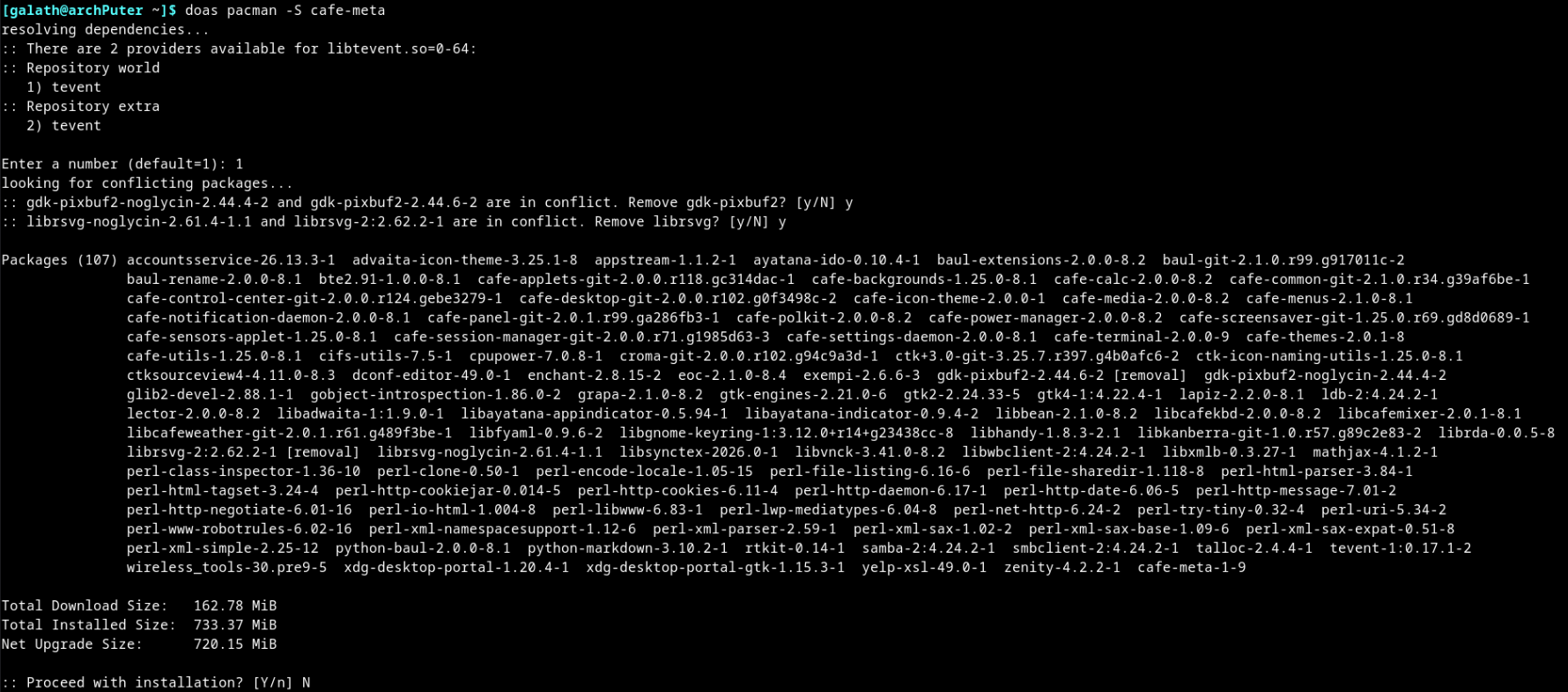
- There's CAFE desktop, forked from MATE; with their own GUI toolkit (CTK, forked from GTK3). I don't know anything else about this one, except for the lack of available packages. 25/5/2026 Update : artist from Artix packaged CAFE, and I find them disturbingly bloated. Though time will tell (especially important, since CAFE was considered experimental at the time of writing) if it was a fuckup on my part (for cafe‐meta) or if CAFE needed more time in the oven.
- LX(DE/Qt) could be an attractive solution considering its lighter resource use, but the lack of customizations rubbed me the wrong way.
- Cosmic... not sure. Aside from Rust & Wayland but those weren't the right selling points to hook me in. Vaxry of Hyprland also spoke against it in 2024 (archive.org).
Cosmic also requires AccountsService & NetworkManager through cosmic‐settings, a dependency of cosmic‐session.
- Speaking of Hyprland, it seems to be an interesting Wayland compositor (and Vaxry seems to be an interesting fellow, though that is a separate matter). That said, I do not have the expertise and/or time to set up Hyprland and I may have to find Wayland alternatives for the programs of my choice (especially the browsers, considering the UXP folks don't support Wayland), so this mention will have to do for now. Also qt6.
- KDE Plasma is on its way to demand SystemD, with drkongi already doing so. Also Wayland, but Trinity (which I think is the "Pale Moon equivalent" to KDE Plasma) SonicDE (the X11‐only Plasma?) exists.
- Lumina is qt5 and AFAIK was packaged only for Hyperbola GNU/Linux, Joborun, & Void Linux (before I count any of the BSDs I am yet to use or the Wild West known as the AUR). Setting those nitpicks (and my skill issues potentially causing problems setting it up) aside, Lumina's avoidance of Linux‐based tools (like DBus, polkit, & systemd) is enticing.
- EFL (Moksha) is... I dunno. But I see no point in moving to EFL if I had to reinstall some (if not all) of my GTK programs (and that's before I get to any of the qt).
- As for GTK2 (the one GUI toolkit favored by Dig Deeper's community), I'll probably need to research this further, away from a rolling release distro (because I may be forced back in GTK3 when I explicitly tried to get GTK2‐only). 6/5/2026 Update : A Devuan user (archive.org) brought back GTK2 as gtk2‐ng and brought it to AUR. 17/8/2026 Update : gtk2‐ng is now available on Artix galaxy. At the moment of writing, it seems to be mostly usable (I am yet to test it myself) for GTK2 LXDE, though lxdm‐gtk2 still seemed to call for GTK3 via lightdm‐slick‐greeter.
- As efficient tiling windows may be (i3, hyprland, Sway) I am more of a traditional desktop user (from a Windows user background) so I'm not sure if I want to go for tiling.
double‐dipping gtk & qt?
Not sure. Personally, my reservations against qt mainly lies in keeping my systems running on one GUI toolkit and keeping the system theme as unified as possible (which is easier under one GUI toolkit). Then again, I readily list these use cases.
- If I ever thought of playing emulated games (mgba and/or ppsspp) on my T470, maybe I would. But then again, those were the only use‐cases I can think of that would justify me adding qt5 to my GTK3 setup and AFAIK I am not much of a Game Boy Advanced player (not to mention PSP is already covered). And if I want to, I can skip the doubledip by using AppImages.
- If I switched to a qt‐based desktop environment like Hyprland, Lumina, LXQt, SonicDE (or Plasma), or Trinity. But then I am forced to double dip for reasons that I list below.
- Artix doesn't provide a Qt (or Enlightenment for that matter) GUI for connman. Thus, I will either be forced into NetworkManager (which KDE will do anyway); deal with the AUR just for those Qt GUI; or use the GTK GUI. Of course, there's always the terminal if I don't mind overcomplicating (for me, not the machine) something that was as supposedly simple as network management.
That said, I am on NetworkManager so this point is only necessary if I figured connman out to my preferences.
- Certain stuff are GTK‐only (GTK2/3/4) or qt‐only. I could probably find qt alternatives for Geany & Pragha if I want to, but the browsers (Basilisk / Pale Moon) lack acceptable qt equivalents. And the same also applies to qt6 with OpenSnitch topping the list (where GTK3 lacked a functional application‐aware firewall and/or network monitor other than GUFW).
- If I found a personal use case for dual (GTK & qt) toolkit programs and needed the program in my T470. Currently, the latest versions of Audacity & Tenacity are here thanks to their suil dependency which requires qt5‐base & qt5‐x11extras. In addition, a bit of STFW seems to show Audacity having plans to switch to qt6 by v4.0.
I didn't keep Audacity / Tenacity on my T470 because I have an old version of Audacity (firewalled from the internet) on my G531GD, which I didn't use often enough (at least, not often enough that I need to have them on the T470).
- 26/7/2026 Update : With AppImages, I can skip installing qt on my system. Though getting a reliable shortcut (other than simply putting the AppImage on Desktop) will be its own thing that I am yet to do.
TL;DR
Straight to the point? Alright then.
- Fixed vs. rolling release don't matter to me.
- Distros don't necessarily matter. That said I'm based on Artix.
- My Linux journey looked a bit like this : Various Windows > Linux Mint > random Linux distros & DEs > Manjaro > Arch > Artix (and then a bit of Devuan before backing off to Artix)
- Dinit as init for now, though sysvinit is nice. Though on the long run I steer clear of systemd (and elogind if I can help it).
- As I'm on XFCE (as offered by Artix) I glue myself to X11 (XOrg) & GTK3. Though I am interested to see Lumina (or some other pure GTK2 environment, especially in a rolling release) in action.
Back to top
Main Page